
Thanks to the Russell Square summer newsletter for this fascinating piece. The full newsletter is available in the cafe. It’s a fascinating read covering everything from roses to railings – and even managing to find a link between Russell Square and the Mad Hatter!
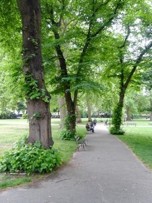
There are more than ten lime trees in Russell Square, many easily identified by a mass of suckers that sprout around the base of their trunks. The old English name for lime trees was Lind and outside the UK they are often referred to as Linden trees. In summer, their heart-shaped leaves are joined by thousands of fragrant cream flowers whose sweet nectar can be smelled from a fair distance and is irresistible to bees. The trees also attract lime aphids which feed on the undersides of the leaves, depositing a sugary substance known as honeydew – an unwanted sticky stuff that drops on any object that lies beneath. Tragically what also lies below flowering lime trees are the bodies of exhausted and dying bees (honey and bumble).
This phenomenon was observed as long ago as 1551, yet is still not fully understood. There was a theory that chemicals in the nectar might be deceiving the bees into persistent foraging after the nectar is depleted, leading to their eventual starvation. This was found not to be the cause, but it is known that lime tree nectar contains small amounts of caffeine. It would seem that bees find the smell of coffee every bit as addictive as we do!
 Bloomsbury Squares & Gardens